

Why human-centered AI is the difference between insight and action
Natural gas trading moves fast.
When a cold front rolls in after the morning scheduling cycle closes, decisions can’t wait. A team at a regional energy company needs to know, immediately, how exposed they are in key markets, how actual demand compares to forecast, and what’s driving margin compression. Historically, getting those answers meant emailing an analytics team and waiting hours for insights that might arrive too late to matter. What’s changing isn’t just the speed of data. It’s who can access insight and how easily.
Populus Group is exploring with an energy client how conversational analytics can allow traders and schedulers to ask business questions in plain English and receive reliable, data driven answers in real time. Not by replacing analysts or automating judgments, but by removing friction between a question and a trustworthy answer. This is human-centered AI in action, and it reflects a larger shift in how organizations are thinking about artificial intelligence.
AI doesn’t create value. People do.
Much of today’s AI conversation focuses on technology: models, copilots, platforms, and agents. But organizations that approach AI as a technology first initiative often struggle with the same outcomes; low adoption, mistrust of outputs, or pilots that never scale beyond experimentation.
Let’s address the elephant in the room: when leadership views AI as a solution for headcount reduction, employees see AI and think job threats. Both sides entrench, adoption stalls, and the technology gets blamed for a people problem. This tension is real and ignoring it is only going to make things worse. Organizations that pursue AI primarily as a cost-reduction lever often discover the savings are short-lived, and the organizational costs are steep. Those that invest in AI as a capability multiplier, keeping people in the loop, in control, and better equipped to do meaningful work, tend to build something more durable.
Human-centered AI starts from a different premise: AI should support how people think, decide, and act, not work around them.
In practice, this means designing AI systems around real workflows and real pressures. It prioritizes clarity over complexity, trust over novelty, and usability over feature density. When AI is aligned with how work actually happens, it doesn’t compete with expertise; it amplifies it.
Returning decision-making to the front lines
In the energy trading example, the breakthrough wasn’t ‘further automation of forecasting’ alone. It was access. By enabling domain experts to engage directly with data (without go-betweens) AI becomes a force multiplier. Traders remain accountable for decisions and risk management. Technology simply shortens the distance between insight and action.
This pattern appears across industries:
- Operations teams getting answers to everyday questions without waiting on reports
- Customer support teams using AI as guidance, not a replacement for human judgment
- Product and strategy teams spotting patterns and issues sooner, with the right context
In each case, the value lies in speed with accountability, not automation for its own sake.
Why Human-Centered AI Efforts Stall
Despite broad agreement on these principles, human-centered AI is often harder to deliver than promised.
Common challenges include:
- Chasing trends instead of real business needs
- Relying on data people don’t trust
- Adding governance and risk checks too late
- Expecting users to adapt their workflows to AI, rather than the other way around
The result is skepticism, workarounds, and underutilized solutions, regardless of how advanced the underlying technology may be.

Where Populus Group Fits In
This is where Populus Group’s perspective within IT Project Services comes into focus. Rather than starting with tools, we start with context.
Human-centered AI begins by asking:
- Who makes critical decisions, and under what constraints?
- Where do delays or uncertainty carry the highest cost?
- What does a better decision look like at the moment it’s made?
From there, AI becomes an enabler, not the headline. Trust, governance, data readiness, and workflow alignment are foundational to this approach. Accuracy matters, but consistency, transparency, and accountability matter just as much. Without trust, AI insights remain theoretical, no matter how technically impressive they are.
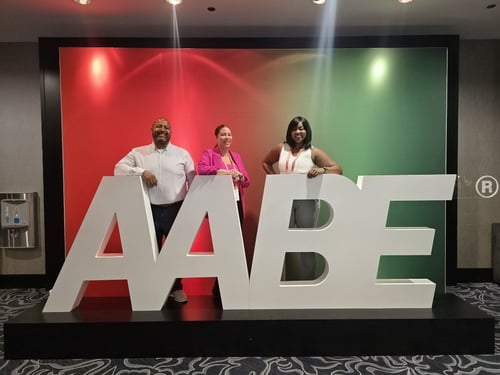
William Hadden, Jasmine Shlekhar & Taniesha Thomas enjoying the energy & AI conversation at AABE in April 2026
When the Technology Recedes, Impact Moves Forward
The most effective human-centered AI systems share one defining trait: they don’t draw attention to themselves. Users don’t feel like they’re “using AI.” They feel like they’re doing their jobs better.
In these environments:
- Interfaces feel intuitive and natural
- Answers arrive with context, not just numbers
- Human judgment remains firmly in control
Technology recedes into the background, while expertise moves to the foreground.
A More Durable Path Forward
As AI capabilities continue to advance, competitive advantage won’t belong to organizations that deploy the most tools. It will belong to those that design AI around the people closest to the problem.
Human-centered AI is not a softer approach; it’s a more sustainable one. It scales because people trust it. It lasts because it respects expertise. And it delivers value because it shortens the distance between insight and action.
That mindset is shaping how Populus Group approaches human-centered AI across IT Project Services and how organizations can turn AI from a promising technology into a practical, trusted part of everyday decision-making.
If your organization is looking to implement human-centered AI or explore how our IT Project Services can support smarter, more actionable outcomes, we’d love to connect. Visit our IT Project Services page to learn more. Reach out to us if you have any questions.
Leave a comment