



For employers trying to fill STEM, engineering, and other specialized technical roles, the challenge is not always a lack of talent. Sometimes, it is a lack of visibility into the talent pipelines already available. That's exactly why Optional Practical Training, or OPT, deserves more attention.
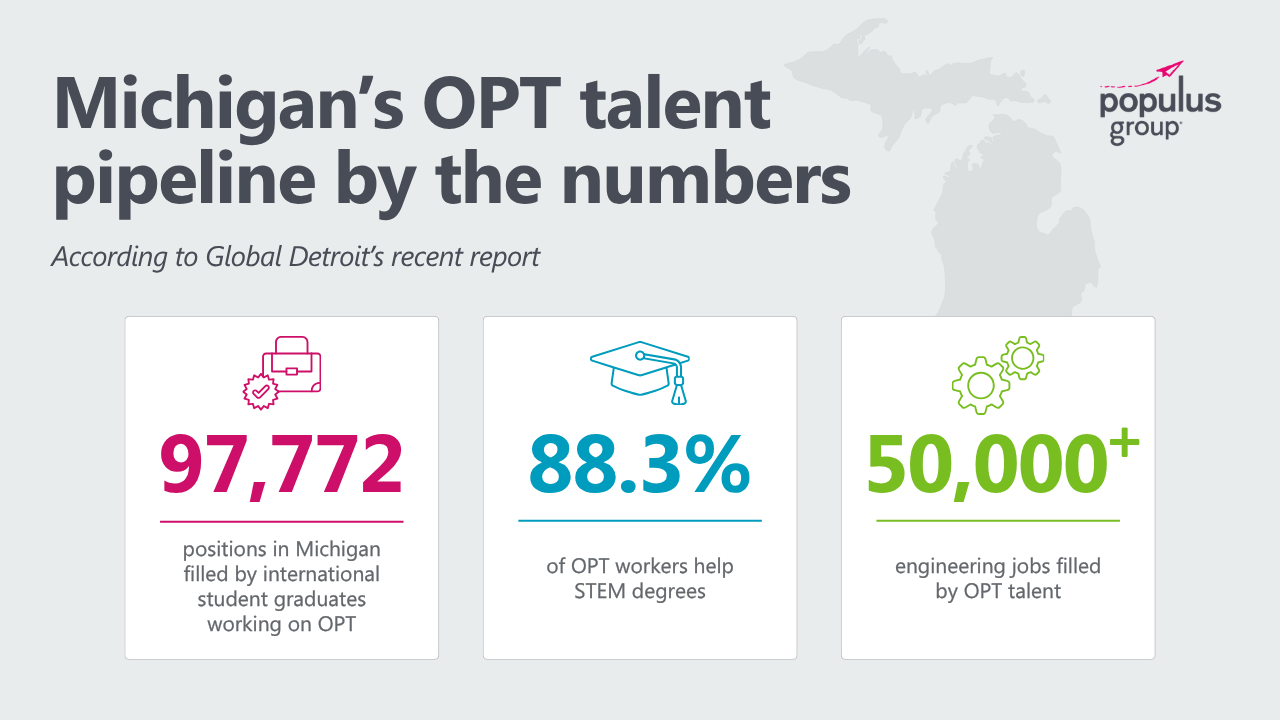
According to Global Detroit’s recent report, international student graduates working on OPT filled 97,772 positions in Michigan from 2013 to 2022. Of those workers, 88.3% held STEM degrees, and more than 50,000 engineering jobs were filled by OPT talent during that same period. Those numbers make one thing clear: OPT talent is not a niche hiring path. It's already playing a huge role in helping employers fill hard-to-staff positions.
What is OPT?
OPT, short for Optional Practical Training, gives eligible international students temporary work authorization after graduation so they can gain experience in roles tied to their degree. Standard OPT provides up to 12 months of employment eligibility, and eligible STEM graduates may qualify for a 24-month extension, allowing for up to 36 months total.
For employers that are unfamiliar with the process, these stats sometimes come as a surprise. There's a common assumption that hiring international student talent automatically means high costs, legal complexity, and administrative burden. But not with OPT! The process is managed through the student and their institution, making it more accessible for employers who want to broaden their talent strategy.
Why employers use OPT talent
The biggest reason is simple: the demand for skilled talent is real, and OPT can help employers tap into candidates they may otherwise miss.
For employers, OPT creates access to highly educated talent, especially in fields where open roles are difficult to fill and competition is high. It can also help organizations widen their talent pool without immediately stepping into a more complex sponsorship process. This is not a niche workforce trend. It is a real hiring strategy already being used at scale.
 Why OPT matters for hard-to-fill roles
When employers talk about hiring challenges, STEM and technical roles are often at the center of the conversation. Engineering, IT, advanced manufacturing, and other specialized functions require skill sets that are not always easy to source through traditional pipelines alone.
That is where OPT matters.
Global Detroit’s findings show that engineering made up more than half of Michigan’s OPT roles during the period studied, and STEM workers represented the overwhelming majority of OPT talent in the state. For employers, that means OPT talent should not be viewed as a backup plan. It should be part of the conversation when thinking about how to fill specialized roles, improve access to qualified candidates, and build a more future-ready workforce.
The opportunity employers may be missing
One of the most important takeaways from Global Detroit’s report is that Michigan does not lack high-skilled STEM talent. What it lacks is a fully coordinated system to retain and deploy it.
Too often, international student talent is overlooked because employers assume it will be too complicated, too risky, or too unfamiliar. In reality, many of these candidates are already here, already trained, and already looking for opportunities to contribute in the industries that need them most. For employers, overlooking OPT talent can mean overlooking a practical solution to real hiring gaps.
 PG’s perspective on global talent
At Populus Group, we have seen firsthand how global talent can strengthen teams and support business growth, especially in hard-to-fill STEM and technical roles.
As Brandon Byrd, our Director of Foreign National Talent Management, shared in Global Detroit’s executive summary, many of the most qualified candidates in IT require sponsorship, and aligning company values with industry demand has helped PG fill hard-to-hire STEM roles, drive business growth, and strengthen Michigan’s reputation as a destination for highly skilled professionals.
.png?width=708&height=398&name=byrd%20quote%20(1).png)
International student talent is already contributing to Michigan’s workforce and economy in a measurable way, contributing to more than $1.4 billion annually to the economy while supporting research, innovation, and long-term talent development. For employers trying to fill hard-to-staff roles, OPT is worth a closer look. It's practical, accessible, and when approached strategically, it can be a meaningful part of a stronger workforce plan.
If your organization is looking for better ways to fill STEM, engineering, or technical roles, OPT talent may be one of the clearest opportunities already in front of you. Learn more about our services in this Michigan Global Talent article and reach out to us for help at the link below!

Leave a comment